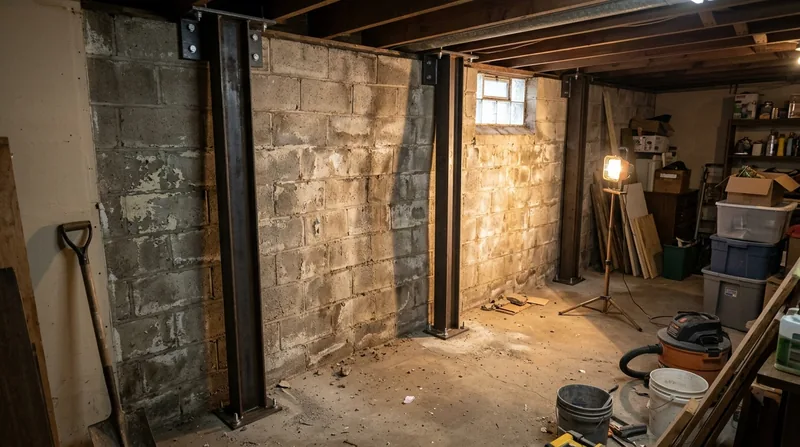




Bowing Wall Repair in Canton: Stop the Movement Before It Gets Worse
Canton sits on glacial till and heavy clay over shale, and that ground holds water like a sponge every spring. When the clay swells against an old stone, brick, or block foundation, the wall has nowhere to go but inward. That is how a Bowing Wall Repair in Canton job usually starts: a homeowner in Hills and Dales or on the older east side streets notices a wall leaning in, a horizontal crack at mid-height, or a door that suddenly sticks. We stabilize bowing and leaning foundation walls with carbon fiber straps, steel I-beams, or wall anchors, matched to how far the wall has moved and how much wet clay is pushing on it. The freeze-thaw cycle here opens joints in older block walls, and the Nimishillen Creek and Tuscarawas River valleys push the water table up fast after heavy rain. If you are already seeing water at the wall, start with our basement waterproofing service so we treat the pressure and the movement together.
Why Bowing Walls Are Common in Canton's Older Basements
Most of the bowing walls we see in Canton are in 1900s to 1930s brick and frame houses with full basements of stone, brick, or early block. Those walls were never designed for the hydrostatic pressure that saturated glacial clay puts on them. Add fifty or sixty freeze-thaw winters, and the mortar joints soften while the wall bulges inward at mid-height. The 1940s to 1960s brick ranches on the south and east sides show the same pattern, often with a partly finished basement hiding the crack line.
- Horizontal cracks at mid-wall signal pressure pushing the wall in, not just a settling crack.
- Walls that lean inward at the top usually need anchors tying back to stable soil.
- Efflorescence and white staining mean water is moving through the wall and evaporating on the face.
- Sticking doors and windows near the wall mean the movement has already changed the frame.
- Block walls that step or shear along a mortar joint need stabilization, not just sealing.
Sealing a bowing wall without addressing the pressure behind it is a temporary fix at best, and it usually fails within a season or two.
Key info: A 1920s brick basement wall in Hills and Dales that bows two inches inward is a different job from a 1970s poured wall in North Canton with a single vertical crack. We measure the movement and check the soil pressure before we recommend straps, beams, or anchors.
Structural foundation repair in Ohio is regulated locally, and the City of Canton Building Department is the authority on permits for wall stabilization and foundation work. Rules vary by jurisdiction, so confirm the permit requirements before any work begins. You can start with the City of Canton official website for department contacts and permit information.
How We Stabilize a Bowing Wall in Canton
We start by mapping the wall: how far it has moved, where the crack line runs, and how the clay is loading it. Then we match the repair to the severity. A wall that has moved less than an inch often takes carbon fiber straps. A wall that is leaning or has moved more takes steel I-beams or wall anchors. We do not sell excavation when stabilization is the right answer, and we do not sell straps when the wall has already sheared.
- We inspect the wall from the inside and check the exterior grade and downspout discharge.
- We measure the bow with a plumb line or laser and record the crack width at several heights.
- We recommend carbon fiber straps, steel I-beams, or wall anchors based on the movement and the soil load.
- We install the system, tie it into the footing and floor framing where required, and torque anchors to spec.
- We seal active cracks with epoxy or polyurethane injection so water does not track through the repair.
- We correct grading and downspout extensions so the clay behind the wall stops taking on water.
Every repair ends with a written record of the movement so you can compare it next spring.
Key info: On a 1950s block ranch near Louisville, the back wall had bowed nearly two inches after a hard freeze. We installed steel I-beams at four-foot spacing and injected the horizontal crack. The wall has not moved since, and the homeowner now has a baseline measurement to check each spring.
If the wall is wet as well as bowed, pair the stabilization with our foundation crack repair so the injection and the structural work happen in the right order.
Bowing Wall Repair Methods We Use in Canton
| Approach | Description | Best for |
|---|---|---|
| Carbon fiber straps | High-strength straps epoxied to the wall face and anchored to the floor and sill. | Block or poured walls with less than one inch of bow and no shear. |
| Steel I-beams | Vertical beams set against the wall and tied into the footing and floor framing. | Walls that have bowed an inch or more and need positive restraint. |
| Wall anchors | Anchors driven into stable soil outside and connected through the wall to an inside plate. | Leaning walls where the top has moved and exterior access is available. |
| Epoxy or polyurethane injection | Ports set along the crack and resin injected to fill the void and seal the wall. | Active cracks that leak after rain, paired with the structural repair. |
| Grading and downspout correction | Regrade the soil to slope away and extend downspouts well past the footing. | Every bowing wall, to reduce the clay pressure that caused the movement. |
The structural repair stops the movement; the water correction keeps the clay from reloading the wall next spring.
Bowing Wall Repair Cost in Canton: What to Expect
Bowing wall repair pricing in Canton starts from $600 for a focused crack injection or a small stabilization detail, and climbs with the length of wall involved and the system chosen. Carbon fiber straps on a short wall are the least expensive structural option. Steel I-beams and wall anchors cost more because they involve more material, more anchoring, and more labor. A full wall that has bowed two inches in a 1920s brick basement is a bigger job than a single strap on a 1970s poured wall in Green.
Access matters too. A wall behind a finished basement ceiling or a furnace takes longer to reach. Soil conditions matter: saturated glacial clay in the Nimishillen Creek valley can require deeper anchors than the same wall on higher ground. Getting two or three estimates is smart because the diagnosis drives the price, and a contractor who measures the bow will quote a different number than one who eyeballs it. Our pricing page lays out the ranges in more detail.
Bowing Wall Repair Near Me: How to Choose a Contractor Near Canton
When you search for bowing wall repair near me in Canton, you will get a mix of dedicated basement waterproofing specialists, general foundation firms, and handymen. Ask each one how they diagnose the wall, not just what they charge. A contractor who measures the bow, checks the exterior grade, and explains why the wall moved is the one worth hiring. One who quotes a number over the phone without seeing the wall is guessing.
- Confirm the contractor is licensed and insured, and ask for a certificate of insurance before work starts.
- Get two or three written estimates that specify the system, the number of straps or beams, and the crack treatment.
- Ask for references from Canton-area homeowners with the same wall type and similar movement.
- Ask who pulls the permit and confirm the work meets City of Canton Building Department requirements.
- Get the warranty terms in writing, including whether it transfers to a new owner.
We are a dedicated basement waterproofing specialist, not a general foundation firm, and we will tell you plainly when simple crack sealing is enough and when the wall needs structural restraint. Reach out through our contact page to schedule a free inspection and get a straight answer on what your wall needs.
Bowing Wall Repair in Canton: Pricing Guide
| Service | Price | Details |
|---|---|---|
| Crack injection only | Starting at $600 | Epoxy or polyurethane injection on an active crack, with ports set and sealed. |
| Carbon fiber straps | Starting at $1,200 | Straps epoxied to the wall and anchored to floor and sill, priced per strap. |
| Steel I-beams | Starting at $2,500 | Vertical beams tied into footing and framing, priced by wall length and access. |
| Wall anchors | On estimate | Exterior soil anchors and interior plates, quoted after measuring the lean and soil load. |
| Travel | Included | in Canton and surrounding areas, no separate call-out or mileage fee |
| Estimate | Free | Response within 24h at (330) 919-5552, no obligation to book |
Indicative pricing, the exact cost depends on square footage, finish, and site access. Free personalized estimate within 24h at (330) 919-5552.


