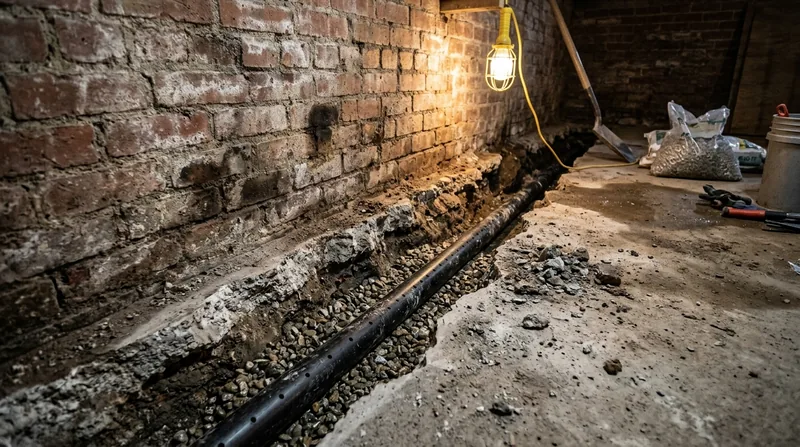




Interior Drain Tile System in Canton
Canton sits on glacial till and heavy clay over shale, and that ground holds water like a sponge every spring. In the older brick and frame houses of Hills and Dales, Downtown, and the east and north side streets, that water finds the footing and pushes up under the slab. An Interior Drain Tile System in Canton captures it at the source and moves it out before it reaches your floor. We install interior perimeter drain tile beneath the slab edge, channel the water to a sump basin, and pump it away from the foundation. It works in any season, which matters when the Nimishillen Creek and Tuscarawas River valleys rise fast after heavy rain. If you are weighing options, start with our basement waterproofing overview and then call us at (330) 919-5552.
Why Interior Drain Tile Matters in Canton's Clay and Older Basements
Most Canton basement seepage is not a crack problem, it is a hydrostatic pressure problem. The clay layer drains slowly, the water table stays high through spring, and water builds under the slab until it finds the cove joint or a block wall seam. In 1940s to 1960s ranches on the south and east sides with partly finished basements, that shows up as wet carpet at the wall line after every soaking rain. In the 1970s to 2000s subdivisions of North Canton, Louisville, and Green, poured concrete walls seep at the joint where the slab meets the footing. Interior drain tile intercepts that water at the footing instead of letting it rise.
- It relieves hydrostatic pressure under the slab, which is the dominant failure mode in Canton's glacial clay soil.
- It captures water at the footing before it reaches the cove joint or the base of a block wall.
- It works alongside a sump basin and pump to move water out and away from the foundation.
- It can be installed in winter, unlike exterior excavation that waits on frozen ground.
- It handles the long freeze-thaw cycle that opens joints in older stone and brick walls.
If your basement is wet after every heavy rain, the footing is the place to solve it, not the wall surface.
Key info: A 1920s brick house near Downtown Canton with a stone footing and a wet north corner is a classic interior drain tile candidate. The water is coming up under the slab, not through the wall face, so sealing the wall alone will not stop it. For the official word on construction and drainage rules in the city, check the City of Canton building department before work begins.
How We Install an Interior Drain Tile System in Canton
We start by finding where the water actually enters, not where the stain shows. A free basement inspection tells us whether the problem is the footing, a wall crack, or a failed existing drain tile. Then we lay out the perimeter run, cut the slab edge, and set the pipe so it drains to the sump basin by gravity. In a 1950s Cape Cod off Tuscarawas Street, that often means a short run along two wet walls rather than a full perimeter, which keeps the job smaller and the cost down. We finish by testing the pump and the check valve before we backfill and pour.
- We inspect the basement, the wall joints, and the exterior grading to confirm the water source.
- We cut a channel along the slab edge and remove the concrete and soil to the footing.
- We set perforated drain tile in washed stone with filter fabric to keep the clay out.
- We tie the run into a new sump basin and install the pump, check valve, and discharge line.
- We pour new concrete over the channel and test the system with water before we leave.
Every run is sized to the walls that actually take water, and we tell you plainly when a smaller repair is enough.
Key info: In a 1970s walkout in Green, the downhill wall stays dry while the uphill corner floods every March. We run interior drain tile along the uphill walls only and tie it to a sump basin, which solves the problem without tearing up the finished side. See our sump pump installation page for how the discharge side is handled.
Interior Drain Tile Approaches We Use in Canton
| Approach | Description | Best for |
|---|---|---|
| Full perimeter interior drain tile | Pipe runs along every wall at the footing and drains to one sump basin. | Basements wet on two or more walls, common in older Canton block foundations. |
| Partial run along wet walls | Drain tile installed only where water actually enters, tied to the existing sump. | One wet corner or a single uphill wall in a walkout. |
| Drain tile tied to a new sump basin | New basin, pump, check valve, and discharge line installed with the tile. | Basements with no sump or an undersized one that floods after spring rain. |
| Replacement of failed existing drain tile | Old clay or collapsed tile is removed and replaced with perforated pipe and stone. | 1950s and 1960s homes where the original footing drain has silted shut. |
| Interior tile with dimple board and vapor barrier | Wall membrane directs seepage down to the tile and controls moisture at the wall. | Finished basements with damp block walls and efflorescence. |
The right approach depends on how many walls take water and whether the existing drain tile still flows.
Interior Drain Tile System Cost in Canton: What to Expect
Interior drain tile is priced by the linear foot of run, so the number of wet walls drives the total. In the Canton market, expect a starting point around $50 per linear foot for a standard interior perimeter run with a new sump basin and pump. A full perimeter on a 1,000 square foot basement runs higher than a partial run along two walls. Access matters too: a basement with a finished ceiling and carpet costs more to open and restore than a bare 1940s ranch. The age of the wall changes the work as well, since stone and brick footings in the older east side streets take more care than a poured wall in North Canton.
We give you a written scope with the linear footage and the pump size spelled out, so you can compare bids on the same terms. Get two or three estimates and ask each contractor whether the price includes the sump basin, the discharge line, and the concrete patch. For a fuller breakdown of what moves the number, see our pricing page.
Choosing an Interior Drain Tile Contractor Near Me in Canton
You want a contractor who works below grade every week, not a general handyman who has done a few basements. Ask for the license and insurance certificate, and confirm the coverage is current before anyone cuts your slab. Get at least two written estimates with the linear footage stated, and ask for references from Canton jobs similar to yours, especially older block or stone foundations. Ask who pulls the permit if the work alters drainage or the sump discharge connection, because rules vary by jurisdiction and the local building department has the final word. A contractor who hesitates on those questions is telling you something.
Reach out through our contact page to schedule a free basement inspection, or call (330) 919-5552.
Interior Drain Tile System in Canton: Pricing Guide
| Service | Price | Details |
|---|---|---|
| Partial interior drain tile run | Starting at $50/linear ft | Includes cutting the slab edge, perforated pipe, washed stone, and concrete patch along the wet walls. |
| Full perimeter interior drain tile | Starting at $65/linear ft | Covers all four walls, tied to a new sump basin; total depends on basement size and wall condition. |
| Drain tile with new sump basin and pump | Starting at $1,800 | Includes basin, pump, check valve, and discharge line; pump horsepower and discharge routing move the price. |
| Replacement of failed existing drain tile | On estimate | Old clay or collapsed tile removal needs an on-site look before we quote the footage and access. |
| Travel | Included | In Canton and surrounding areas, no separate call-out or mileage fee. |
| Estimate | Free | Response within 24h at (330) 919-5552, no obligation to book. |
Indicative pricing, the exact cost depends on square footage, finish, and site access. Free personalized estimate within 24h at (330) 919-5552.


