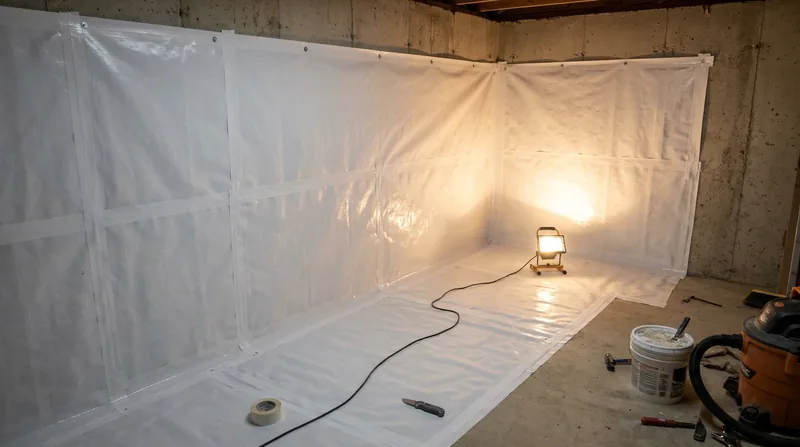




Vapor Barrier Installation in Canton: Stop Ground Moisture Before It Reaches Your Walls
Canton sits on glacial till and heavy clay over shale, and that ground holds water like a sponge every spring. In the older brick and frame houses of Hills and Dales, Downtown, and the east and north side streets, that moisture vapor pushes through stone, brick, and early block walls and condenses on cool basement surfaces. We install Vapor Barrier Installation in Canton as a sealed system across walls and slab, not a sheet of plastic stapled to a joist. The goal is simple: block ground vapor from entering the living space and route any liquid water to the sump. If you are still deciding between barrier work and drainage, start with our basement waterproofing service page to see how the pieces fit together.
Why Vapor Barriers Matter in Canton's Clay and Freeze-Thaw Basements
The dominant failure here is not a single gushing crack. It is chronic vapor drive through old masonry and slab edges, fed by a water table that rises fast in the Nimishillen Creek and Tuscarawas River valleys after heavy rain and snowmelt. Add long freeze-thaw winters that open joints in early block walls and you get damp walls, efflorescence, and a musty basement smell that never quite goes away. A proper barrier controls that moisture at the surface.
- We seal the barrier to the wall plate and floor to stop vapor at the coldest surfaces where condensation forms.
- We overlap and tape every seam so the sheet acts as one continuous membrane, not a patchwork.
- We integrate the bottom edge with the interior perimeter drain and sump basin so liquid water has a path out.
- We leave terminations and penetrations taped and mechanically fastened, not caulked and forgotten.
When the barrier is detailed correctly, the basement stays drier and surface mold growth has far less moisture to work with.
Key info: In 1920s brick basements on Canton's north side, we often find efflorescence on the lower block courses and damp drywall on the finished side. That pattern points to vapor drive through the wall, not a leaking pipe, and a sealed barrier with sump integration is the right first step.
Ohio's building and contractor licensing rules are administered at the state level, and you can verify a contractor through the Ohio Department of Commerce before any work begins.
How We Install a Vapor Barrier in a Canton Basement
Every job starts with a walkthrough to find where the moisture is actually coming from. In the 1940s to 1960s ranches on the south and east sides, that is often a partly finished basement with a failing wall finish and damp slab. In the 1970s to 2000s subdivisions in North Canton, Louisville, and Green, it is usually poured walls with cold joints and a slab that sweats in summer. The install sequence is the same, but the detailing changes with the wall type.
- We inspect the walls, slab, and drain tile, and note any active seepage, efflorescence, or bowing that needs separate repair.
- We clear the perimeter and confirm the interior drain and sump basin are open and functioning.
- We fasten the barrier to the upper wall with a continuous termination strip and seal the top edge.
- We run the sheet down over the wall-to-floor joint and lap it into the drain channel or sump pit.
- We tape all seams, penetrations, and pipe boots with a compatible membrane tape.
- We test the sump and check valve, then walk the job with you before we pack up.
If the inspection turns up a wall that is moving, we stop and talk about bowing wall repair before covering anything with a barrier.
Local example: A 1950s Cape Cod in Louisville had a damp finished wall and a musty smell every March. The slab was dry and the drain tile was clear, so we installed a sealed wall barrier with a taped bottom lap into the existing sump. No excavation was needed.
Vapor Barrier Approaches We Use in Canton
Not every basement needs the same membrane or the same level of detailing. We match the approach to the wall material, the amount of vapor drive, and whether the space is finished or will be finished later.
| Approach | Description | Best for |
|---|---|---|
| Heavy-duty wall sheet | Reinforced poly membrane fastened to the upper wall, lapped into the drain. | Damp stone, brick, and block walls in older Canton homes. |
| Dimple board drainage mat | Drainage mat that holds the wall dry and channels water down. | Walls with active seepage before a finish goes on. |
| Slab vapor barrier | Sealed sheet over the floor, lapped and taped at the perimeter. | Sweating slabs and finished floors in poured-wall basements. |
| Sump-integrated system | Barrier tied into the interior drain and sump basin with a sealed termination. | Basements with a water table that rises after heavy rain. |
The right combination depends on what the inspection finds, and we tell you plainly when a simpler detail will do the job.
Vapor Barrier Installation Cost in Canton: What to Expect
Pricing for vapor barrier work starts at $3 per square foot for the barrier and standard detailing. That figure moves with wall height, the number of penetrations, whether the slab is included, and whether the sump needs integration. A small 400 square foot basement in Canal Fulton is a different job from a full walkout in Green with two finished rooms and a dozen pipe penetrations.
Access matters too. A basement packed with shelving, a finished ceiling, or a furnace and water heater tight to the wall adds labor before the first sheet goes up. Older stone walls in Downtown Canton often need parging or spot repair first, and that is quoted separately so you can see exactly what you are paying for. We recommend two or three written estimates on any basement project, and we are glad to walk you through the differences.
For a fuller breakdown of how we price barrier and drainage work, see our pricing overview.
Hiring a Waterproofing Contractor Near Canton: What to Check
Basement moisture work is a specialty, and the contractor you choose should be able to explain the difference between vapor control and liquid water control without a sales pitch. Ask for proof of licensing and insurance, and ask what happens if the basement is still damp after the install. A written scope and a clear call-back policy matter more than a glossy brochure.
- Confirm the company is licensed and insured, and ask for a certificate before work starts.
- Get two or three written estimates with the same scope so you can compare them fairly.
- Ask for local references from basements similar to yours, in Canton or a nearby city.
- Check whether a permit is required for any drainage or sump discharge changes, and confirm with the local building department.
- Ask how the barrier ties into the existing drain and sump, and who handles the sump if it fails.
If a contractor cannot answer those questions on the spot, keep looking. You can reach us through our contact page to schedule a free basement inspection.
Key info: We serve Canton and the surrounding communities, including North Canton, Massillon, Louisville, Alliance, and Canal Fulton. If you are in the 44702 or 44709 ZIP codes, our Canton vapor barrier page has the local details.
Vapor Barrier Installation in Canton: Pricing Guide
| Service | Price | Details |
|---|---|---|
| Wall vapor barrier | Starting at $3/sq ft | Includes heavy-duty sheet, termination strip, taped seams, and lap into the existing drain. |
| Wall and slab barrier | Starting at $5/sq ft | Adds sealed slab sheet and perimeter lap; price rises with penetrations and floor prep. |
| Sump-integrated barrier system | On estimate | Requires an on-site look at the drain, sump basin, and discharge before we quote. |
| Travel | Included | In Canton and surrounding areas, no separate call-out or mileage fee. |
| Estimate | Free | Response within 24h at (330) 919-5552, no obligation to book. |
Indicative pricing, the exact cost depends on square footage, finish, and site access. Free personalized estimate within 24h at (330) 919-5552.


